

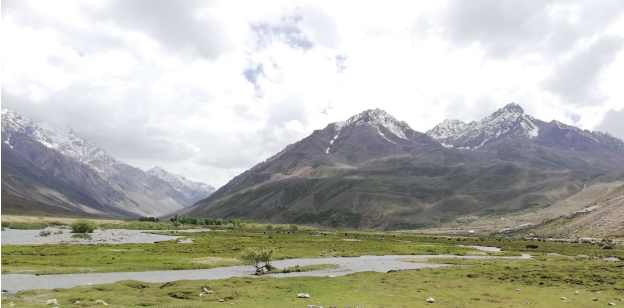
Pakistan has a diversified landscape covering from mountainous ranges to vast plains of green land. The north of Pakistan is covered with three vast mountainous ranges of the Karakoram, the Himalayas, and the Hindu Kush ranges. There are numerous world-famous eight-thousand-meter mountains, with altitudes exceeding 8000 meters, in these ranges, including K2, Nanga Parbat, and Tirich Mir. These are also famous for climbers from all over the world to climb these, and tourists always have a dream to have an adventure in these most famous mountains and peaks in Pakistan.
K2
K2, also known as Mount Godwin Austen, is the 2nd highest mountain with an elevation of 8,611 meters above sea level. It is located in the Gilgit-Baltistan in the Karakoram Range along the border between China and Pakistan. It was first climbed by the Italian climbers Lino Lacedelli and Achille Compagnoni in 1954. K2 is only visible from the end of the Baltoro Glacier. It is more difficult to ascend compared to Mount Everest, the world’s tallest mountain in Nepal. All of the routes and K2 base camps are located in Pakistan side, where Abruzzi Spur and North Ridge are common.
Broad Peak
Broad Peak is also located in the Karakoram range in the Gilgit-Baltistan on the border between China and Pakistan. It is also included in the list of eight-thousanders and is the 12th highest mountain in the world, having the altitude of 8,051 meters above sea level. Its summit was attained in 1957 by Austrian climbers Fritz Wintersteller, Hermann Buhl, Marcus Schmuck, and Kurt Diemberger. It is a part of the Gasherbrum massif in Gilgit-Baltistan and is named due to its vast peak extending over one and a half kilometres. Windy Gap is the mountain pass between K2 and Broad Peak at an elevation of 6,111 meters.
Gasherbrum I
Gasherbrum I, known as K5 and Hidden Peak, is located in the Shigar district of the Gilgit Baltistan on the border of China and Pakistan. It is the 11th highest mountain at 8,080 meters above sea level. It is the major part of the Gasherbrum Massif, also known as Shining wall. It was first climbed by Andy Kauffman and Pete Schoening, a team of American, in 1958.
Gasherbrum II
Gasherbrum II, known as K4, is also part of Gasherbrum Massif and considered as the 13th highest mountain in the world with an elevation of 8.035 meters. Its summit was achieved in 1956 by Austrian team including Josef Larch, Fritz Moravec, and Hans Willenpart. It is the third highest peak in the Gasherbrum massif.
Nanga Parbat
Nanga Parbat is located at the border of the Diamer and Astore districts and is the 9th highest mountain in the world with an elevation of 8126 meters above sea level. It is located in the Himalayas Range in Gilgit-Baltistan region. It has the 2nd highest prominence behind Mount Everest. It is also known as Killer Mountain due to its extreme difficult climb. It is also a fastest growing mountain in the world. The Rupal Face of Nanga Parbat, having 4,600 meters height, is the highest mountain face in the world. It is clearly seen from the Karakoram Highway in Diamer district. It was first climbed in 1953 by Hermann Buhl in German-Austrian Nanga Parbat expedition.
Tirich Mir
Tirich Mir is the highest mountain in the Hindu Kush Range and considered as the 33rd highest peak in the world, with the elevation of 7,708 meters. It is located in the Chitral district in Khyber Pakhtunkhwa, Pakistan. The peak is clearly seen from the main bazaar of the Tirich valley leading to Tirich Glacier toward the Tirich Mir summit. It was first climbed in 1950 by A. Naess, Per Kvernberg, T. Streather, and Henry Berg, in a Norwegian-British expedition.
Rakaposhi
Rakaposhi, also known as Dumani, is the 27th highest mountain in the world with an elevation of 7,788 meters. It is located in the Karakoram range in Gilgit Baltistan in Nagar District in the center of Nagar and Bagrote valley. It is easiest peak and can be descends without any interruption to its base camp. It was first climbed by Mike Banks and Tom Patey, a team of British expedition, in 1958. It gives a clear view from the Karakoram Highway near the Nagar valley. Rakaposhi Basecamp is one of the most popular trekking destinations in the region, offering breathtaking close-up views of the massive peak and surrounding glaciers.
Tourism and Adventure
These mountain peaks are always available for tourists to have different type of adventures. Trekking to base camp, as well as performing the summit expeditions for professional climbers, can be planned in different weathers by getting guidelines from local tourism offices as well as from visiting Beauty of Pakistan. It must be kept in mind to get all type of guidelines as well as proper training before doing any type of expedition as these mountainous treks are dangerous without proper guide. Trekking to base camp is easy and can be done with little efforts and travel guide, whereas climbing to summit must be planned with professional climbers with all specialize equipment.
Protect Environment
It is an obligatory duty of every tourist to protect the environment of these mountain peaks by avoiding garbage and pollution. As all of these impact the environment negatively by rising the temperature and melting of glaciers in these areas. The situation of melting glaciers and rising temperature are already alarming due to climate change effect in the region.
Conclusion
It is one of the most fantastic opportunities for tourists to enjoy the beauty of the most of the world highest peaks in Pakistan. They can explore the most of the unseen treks with unique experience of adventure that they have never before. To enjoy one of the world highest adventures with unforgettable event of their lives, one must visit Pakistan.